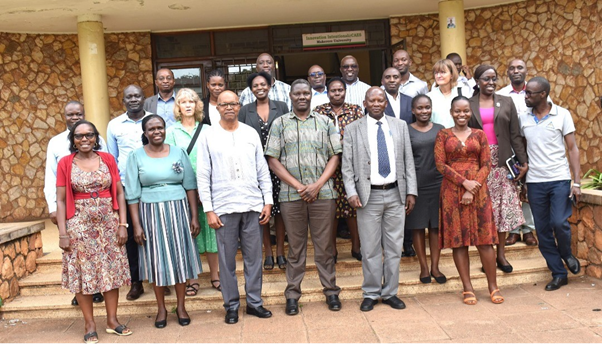
Inception Meeting at Makerere University’s College of Agricultural and Environmental Sciences (CAES), from 14th–15th August 2025.
Project Title: Climate-resilient soybean as lipid-based nutrient food supplement for improved health, growth and development of stunted children in Uganda (Healthy Soy)
Project Description
The "Healthy Soy" project addresses the critical challenges posed by climate change, such as drought, unpredictable rainfall, and reduced crop yields, which lead to food insecurity and malnutrition. These issues disproportionately affect poor farmers and children, with malnourished children requiring high-quality protein to support catch-up growth. Soy protein, being a high-quality plant-based protein, is central to the project's efforts to combat these challenges. By addressing these interconnected challenges, the project aims to improve child nutrition, support smallholder farmers, and contribute to sustainable agricultural practices in Uganda, aligning with global Sustainable Development Goals (SDGs).
The project is structured around four interrelated objectives, each aligned to a specific work package and led by specialized academic units in Makerere University and University of Copenhagen. CHDC houses the Mak Health work package 3: Effects of Soy protein on children’s growth and health.
First, the project aims to identify climate-smart soybean varieties by selecting three high-protein, low-antinutrient, and climate-resilient varieties suitable for Eastern, Northern, and Western Uganda. Second, it seeks to develop optimized soybean processing protocols that reduce antinutrients and enhance protein bioavailability to better support child growth.
Third, the project will evaluate the effectiveness of locally produced soy-based lipid-based nutrient supplements (LNS) through clinical trials, assessing their impact on the growth, body composition, and health of children affected by stunting. Finally, it focuses on strengthening research capacity through training PhD students, hosting research seminars, and engaging stakeholders to support knowledge dissemination and uptake.
Methodology
This 5-year project is organised into 4 work packages (WPs) 1) Climate-resilient soybeans, 2) Soy protein and antinutrients, 3) Effect of soy protein on children’s growth and health and 4) Management, capacity building and dissemination (Figure 1).
The project is expected to deliver several key outputs that contribute to both scientific advancement and practical impact. These include the selection of three climate-resilient, nutritionally rich soybean varieties; the development of optimal soybean processing protocols; and the formulation of locally produced soy-based lipid-based nutrient supplements (LNS). In addition, the project will generate 12–15 peer-reviewed publications, support the training of three PhD and two MSc students, and facilitate stakeholder engagement through workshops, research seminars, and the production of technical and policy briefs.
Collectively, these outputs will lead to improved soybean varieties, enhanced nutritional solutions for vulnerable populations, and strengthened local research, innovation, and production capacity.
Target Group Reach
The project primarily targets children aged 6 months to 5 years who are affected by stunting, aiming to improve their nutritional status and overall health outcomes. Secondary beneficiaries include smallholder farmers, particularly women engaged in soybean cultivation, as well as local food producers, nutritionists, policymakers, and the broader community who will benefit from improved agricultural practices, nutrition solutions, and evidence-based interventions.
Project Locations
The project is implemented across multiple regions in Uganda to ensure broad relevance and impact. Field trials and experiments are conducted in Northern, Eastern, and Western Uganda, targeting the country’s major soybean-growing areas. Laboratory analysis and product development take place at the Makerere University Agricultural Research Institute and the Food Science & Technology Department, while clinical trials are carried out in high stunting-prevalence communities in Jinja.
Funders: Danish Ministry of Foreign Affairs (through DANIDA/DFC)
Primary Collaborators:
The project brings together a strong multidisciplinary and international consortium of collaborators. The University of Copenhagen leads on protein quality, nutrition research, and overall international coordination, while Makerere University spearheads soybean breeding, processing, and child health clinical trials. RECO Industries plays a key role in the local production of soy-based lipid-based nutrient supplements (LNS).
Additional support is provided by Daniel Tomé, alongside institutional partners including the Ministry of Health Uganda and UNICEF, who contribute to policy alignment, technical guidance, and broader dissemination of project outcomes.
PIs and Co-Investigators and their affiliations are listed below:
Principal Investigators:
Benedikte Grenov, Associate Professor, PhD, Department of Nutrition Exercise and Sports University of Copenhagen, Denmark. Email: bgr@nexs.ku.dk
| Prof Ezekiel Mupere, Department of Peadiatrics, School of Medicine Makerere University, Uganda Email: mupez@yahoo.com
|
Dorothy Nakimbugwe, Assoc. Professor, PhD Makerere University Email: dnakimbugwe@gmail.com
| Prof. Phinehas Tukamuhabwa School of Agricultural Sciences (SAS) Department of Agriculture and Production Makerere University PO Box 7062 Email: phinehas.tukamuhabwa@mak.ac.ug
|
Significance
The Healthy Soy Project is highly significant as it offers a comprehensive and integrated solution to two critical challenges in Uganda malnutrition and climate resilience. By linking agricultural innovation with nutrition science, the project not only addresses immediate child health needs but also promotes sustainable farming practices, empowers women, and strengthens local food production systems.
Its impact extends beyond direct beneficiaries, with the potential to inform national policies, increase access to affordable and nutrient-rich foods, and contribute to key global priorities, including ending hunger (SDG 2), improving health outcomes (SDG 3), reducing inequalities (SDG 10), and advancing climate action (SDG 13).